

It is symbolic that my first published review was of poet and artist Dovilė Bagdonaitė’s second book, takeliai_žolėje (paths_in_the_grass), published by Baziliskas in 2022. At the time, this poetry collection felt remarkably fresh, vibrant, and memorable. It seemed that, at last, the poems of a contemporary young woman had been written for young people.
In this conceptually accomplished book, as if along the well-trodden paths in the grass of everyday life, Bagdonaitė compellingly juggles irony, the aesthetics of kitsch, and domesticity. Across its pages, the fragility of contemporary life unfolds alongside perfectionism and the exhaustion that accompanies it. As a reader, I also could not help admiring the visual poems, the clever eroticism, and the subtle presence of queerness and social activism. After this publication, my expectations for contemporary Lithuanian poetry rose. To this day, I look for a similar vibrant authenticity and unique voices in poetic texts.
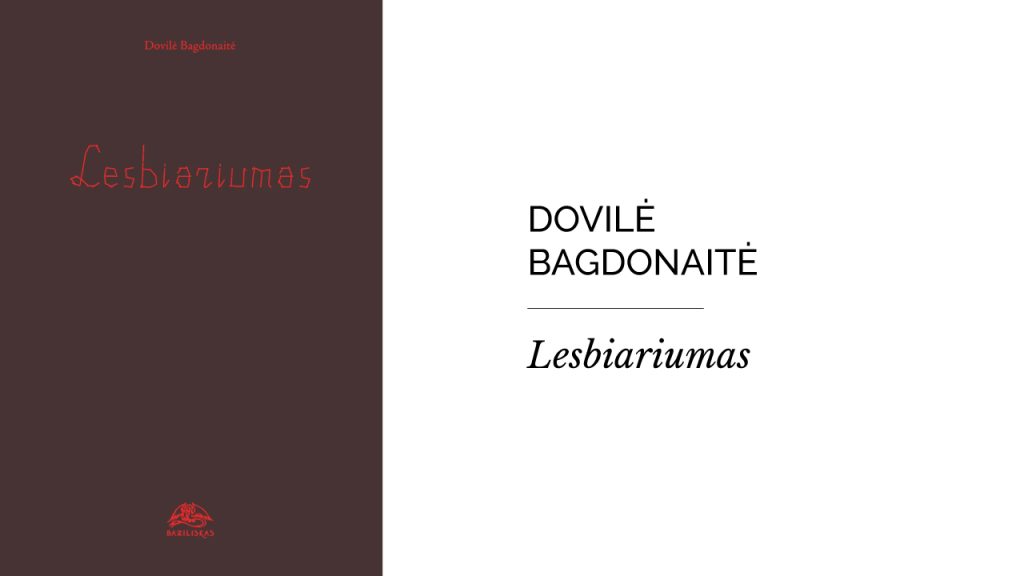
Therefore, when Bagdonaitė’s third poetry collection, Lesbiariumas (Lesbiarium), appeared, I did not rush to read it and wanted to wait for a few comments from people I knew, just in case it proved disappointing. Resembling a zine or chapbook in both its scope and its abundance of visual poems, the book is only fifty pages long, small enough to fit into a pocket, yet visually dense. Dark crimson in color, with faintly gleaming red lettering on the cover, it resembles a mysterious spellbook that reveals itself only from a certain angle.
The book’s contents are exceptionally polished. It contains not a single unnecessary poem, yet that only leaves us wanting more. This time, Bagdonaitė’s project is far more focused. Even the book’s title and its blurb comparison to a herbarium or a bestiary in the annotation are reference to illustrated publications rooted in a tradition dating back to medieval writing, whose purpose was to preserve and classify plants and to describe mythological beings associated with religion and God’s creation.
Admittedly, the classification is not especially pronounced here – it’s subtle. Yet, as in the kinds of publications mentioned above, there is an abundance of illustrations, or rather visual poems. At first glance, the subjects depicted in Bagdonaitė’s Lesbiarium seem to be entirely ordinary phenomena or objects drawn from everyday life: rays of light, stones, fireworks, mist, instant noodles, or tomatoes. Alongside them appear contemporary artifacts associated with various queer and romantic experiences: a paper cut-out of a skeleton in the closet, arrows symbolizing mixed signals, a stop sign and the petals of a loves-me, loves-me-not flower, armor representing a fear of being hurt and uncertainty, a smoke machine, a trap for a vegan, Vi, a queer character from the video game League of Legends and the animated series Arcane, and so on. The beasts of our age take on different forms today.
Even on the book’s back cover is a stylized self-portrait composed of typographic symbols, one that does not allow the author to be identified. It is like an icon that obscures facial features, rendering them anonymous. The visual dimension of Lesbiarium thus suggests that lesbian identity, sometimes very concrete and tangible, and at other times highly abstract, is part of everyday identity and can also be (self-)ironic. It seems that every lesbian can be authentic and unique, yet alienation, apparently, does not discriminate by sexual orientation, and a failure to know the “other” can lead to mystification or caricature. Relationships, therefore, most often romantic and sometimes even platonic, are likened to competitive battles, and to convey this idea, Bagdonaitė draws on various references to action and combat video games as well as fantasy literature, such as The Lord of the Rings or the Harry Potter series.
The romanticism found in Bagdonaitė’s poems not only ironically recalls medieval battles with new monsters, complete with codes of honor and unwritten rules of conduct typical of combat, but is also digitalized and saturated with popular culture. According to Bagdonaitė, contemporary romance is “not what it used to be.” Rather, it is a kind of simulacrum that has lost its magical charm. It is campy and filled with rebound kittens holding champagne and roses as well as supposedly cool but outdated emoticons that the younger generation uses post-ironically. Through her capricious, ironic, and sharp visual language, Bagdonaitė brings to the fore the experiences of young lesbians that, regardless of the era, are shaped by feelings of alienation and discomfort, yet are at once deeply recognizable and painful.
Admittedly, while the book seems to suggest that contemporary relationships and desire are casual and noncommittal, beneath this lies a sincere longing to love and to be loved. This is reflected in the poem “Prrrpoem”:
I’d like to write a poem
so tender
that a kitten would enter it
to lap up some milk
it would tuck a reader in
with a down
blanket and spoon them
as they fell asleep
The narrator expresses a desire to be gentle and sensitive, capable of offering others love and comfort. As a creator, she seeks to convey this desired tenderness through “a good love poem,” yet she understands that she herself will never fully become such a person and that poetry will never turn into reality. It remains only a fiction of letters and symbols.
The narrator of Lesbiarium experiences desire and a longing for genuine feeling, even as she tries to conceal it beneath a mask of irony. This is brought to the fore in the poem “Sad Party Animals,” set in a nightclub where the narrator waits for a girl. Amid the noise, many lights and makeup, amid euphoric dancing and the intimacy of the night, miscommunication intrudes, along with unrequited desire. The club space, crucial to queer identity, typically symbolizes not only the anxieties hidden behind entertainment but also transience itself. It is not a place to look for anything more than a one-night encounter. The narrator is tired and disappointed, and so perceives exhaustion all around her: “the glasses filling with waiting instead of liquid / the ice cubes are melting, tired of work.” And although the poems are rich in queerness, they also capture with remarkable precision the loneliness of being young. These experiences may be just as recognizable to heterosexual readers.
To conclude, it is worth mentioning the literary context in which this book has appeared. Although same-sex marriage has not been legalized in Lithuania, and homophobic attitudes remain prevalent in parts of society, even if they are gradually changing from year to year, Lesbiarium forms part of the LGBTQ+ literary boom that has become increasingly noticeable in recent years. It is encouraging to see publishers increasingly bringing out translated queer literature, while Lithuanian authors such as Giedrė Kazlauskaitė (incidentally, the editor of Lesbiarium), Artūras Tereškinas, and Dovilė Bagdonaitė herself are speaking ever more openly in their poetry about their homosexual experiences.
It is worth acknowledging that it is precisely queer poetry that is shaping new vocabularies of contemporary romance, thereby transforming the male gaze on women that has long dominated poetry. Women, so often understood primarily as objects of desire, are granted subjectivity through a lesbian perspective, becoming fully realized subjects in depictions of attraction and love. It is also worth noting that queer writers no longer conceal their identities behind metaphors. Instead, they name themselves clearly and, at times, even bluntly, stepping out of the closet and into the public sphere, leaving little room for readers’ alternative interpretations. At the same time, at least for the authors mentioned above, themes of everyday life, domesticity, transience, and embodiment continue to predominate.
In her latest poetry collection, Bagdonaitė classifies not different prototypes of lesbians or other queer women, but rather archetypal situations of miscommunication, attachment, and unrequited desire – the true monsters and horrors of contemporary relationships. For this reason, we can hope that Lesbiarium, seemingly playful on the surface yet immensely witty and sensitive, will not be lost to time because of its slightness but will instead find the readers it deserves.


