
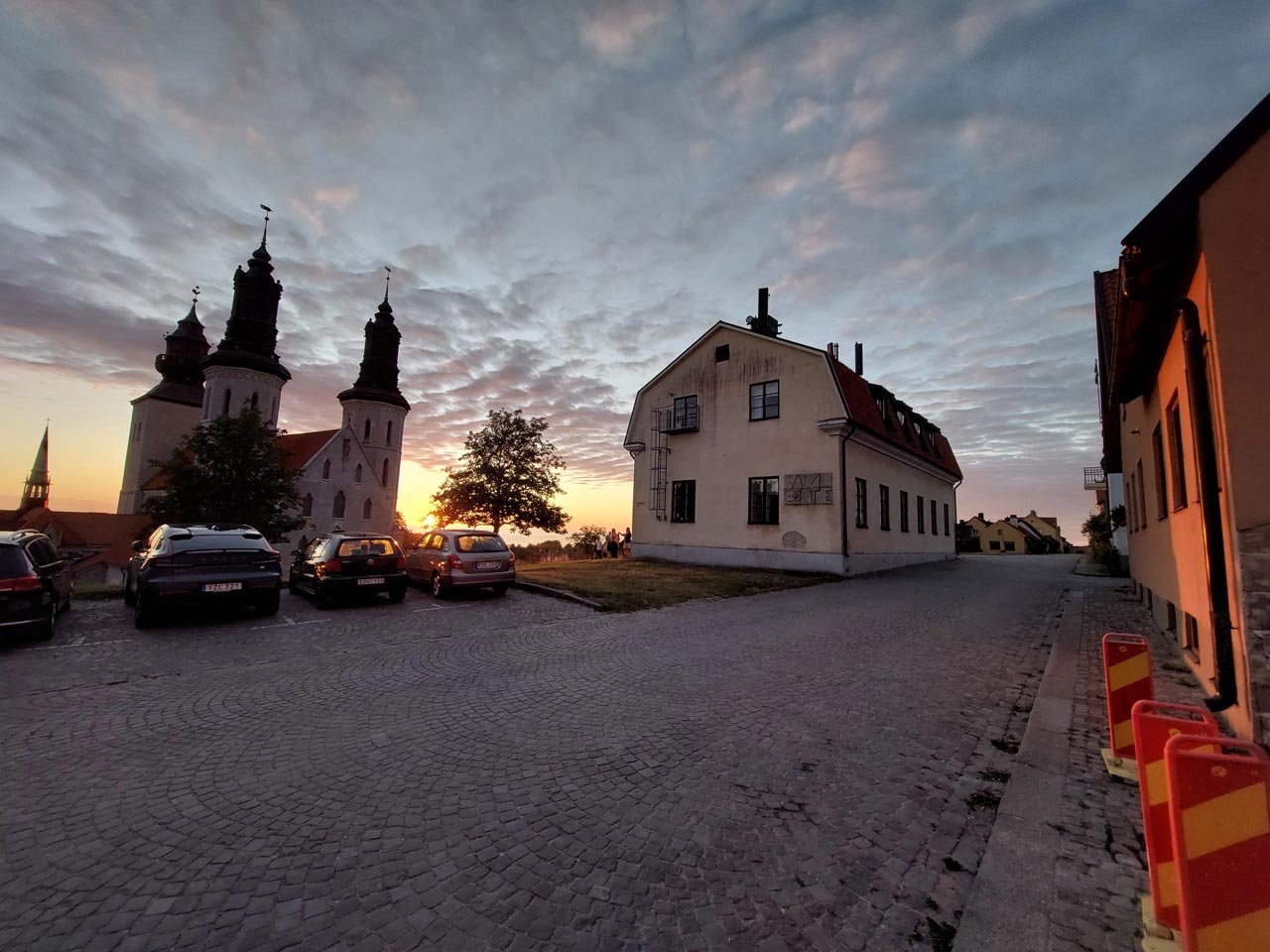
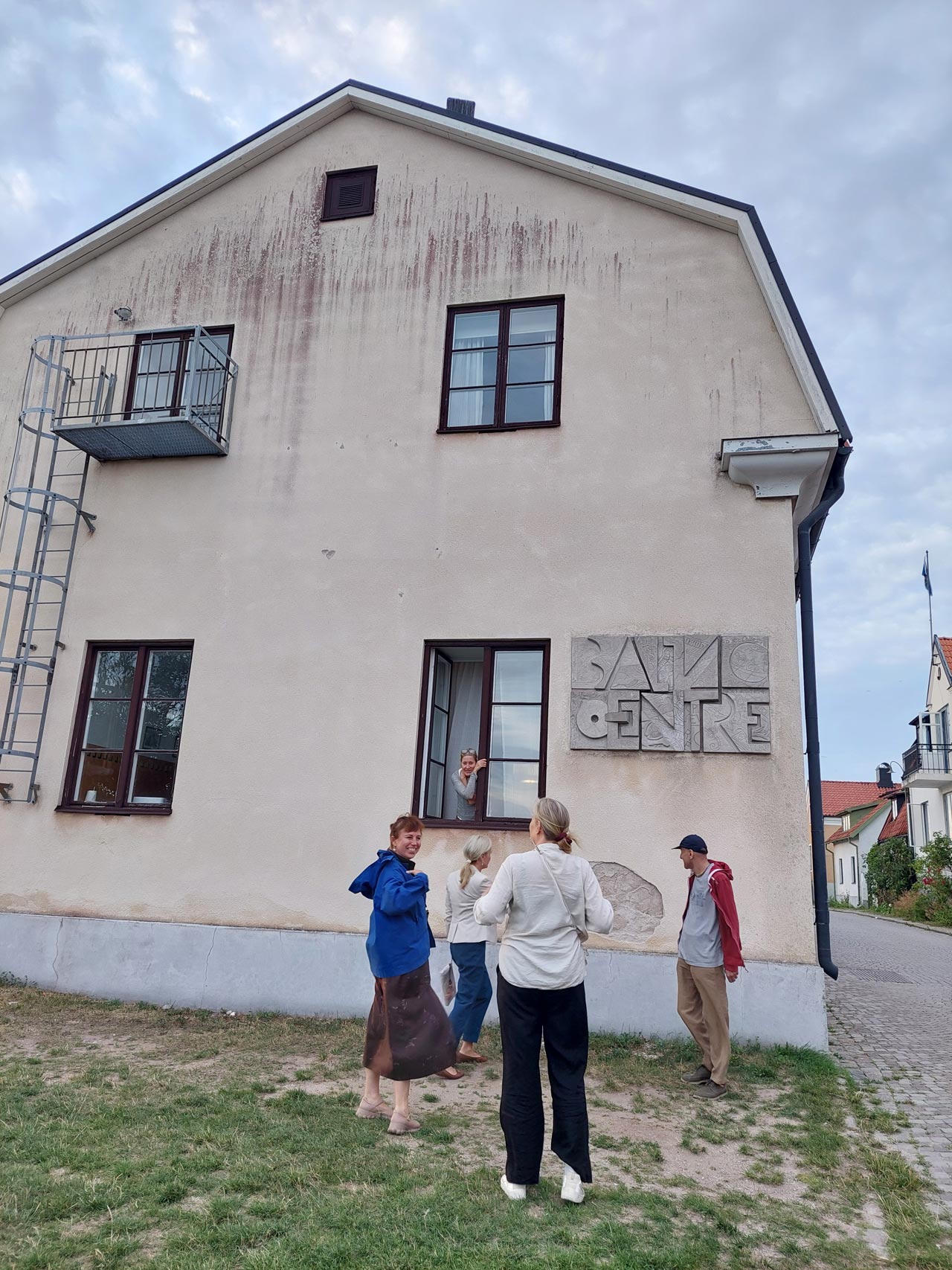
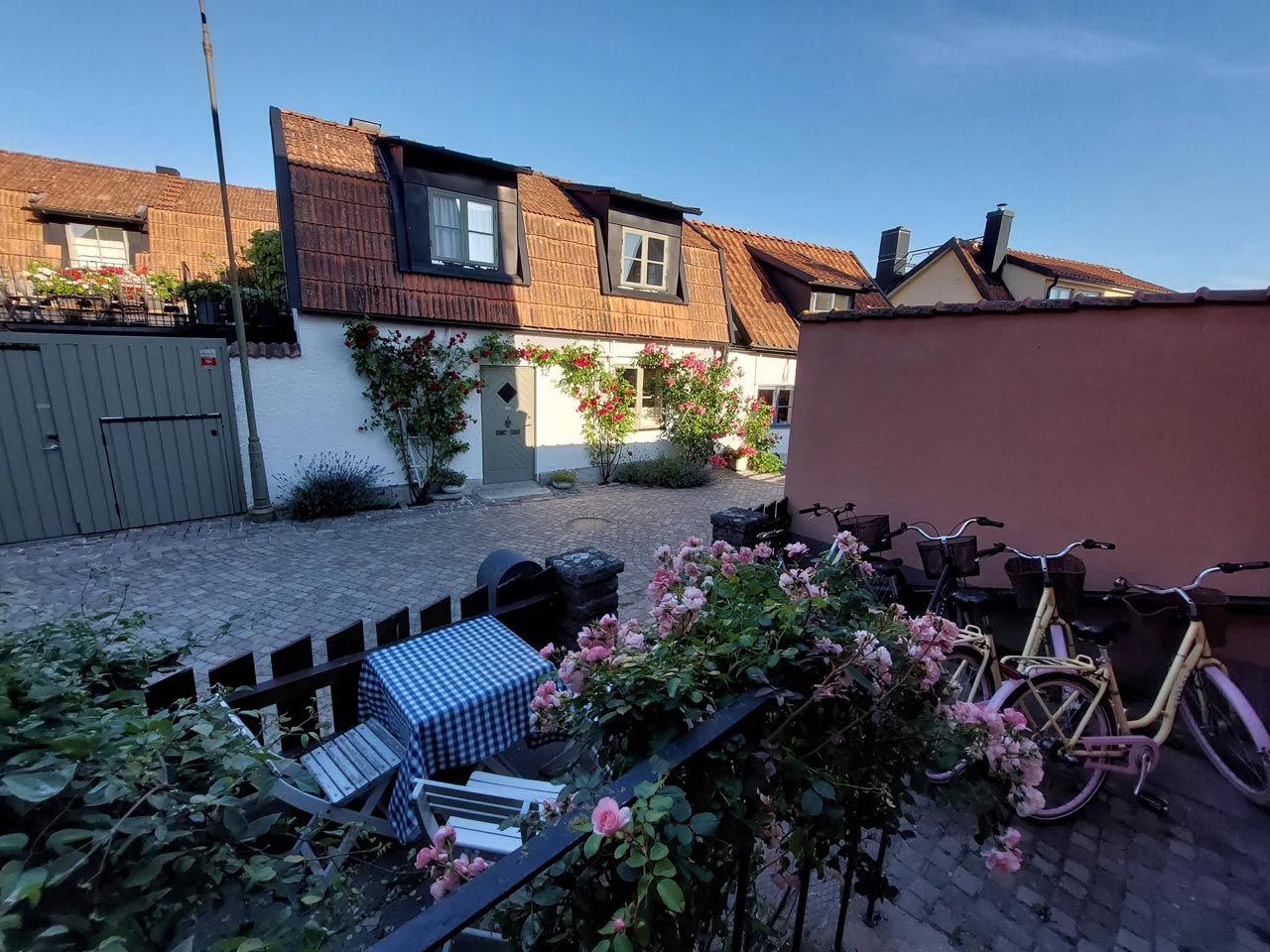
After a long journey, I arrived at the Baltic Center for Writers and Translators and found its director, Lena, pruning roses in the courtyard. After all, I’m back in the town people call “the city of roses and ruins.” The last time I visited this town was four years ago, in May; the roses had not yet bloomed. This year, in July, almost every house in the old town is covered in shrub roses.
I wanted for everything to be just as it was. The same room with a view of the church and the sea, the same people. I didn’t want to get to know any new residents. I was sad that Patrik no longer worked here. Last time, when I lamented how sad I was to leave, he told me, “You’ll come back. Everyone comes back,” and he was right.
How could I forget about the bells? The bells of St. Mary’s Cathedral ring every half hour (even at night!), and at certain hours (at eight in the morning or twelve) they play an additional melody. How are you even supposed to get some sleep here?! Christine, a writer from Gothenburg, told me that when she first arrived, her immediate thought was, Why had no one warned her about the bells?
July is a difficult time to concentrate on work in Visby. The town can be described the way Google describes a shopping mall at peak hours: “as busy as it gets.” Now, for at least a few weeks, I will experience what it’s like for those who live in the old town year-round.
On the day I arrived in Visby, news spread that the poet Aidas Marčėnas had died. I am grateful to him for encouraging me to put together a poetry collection, to enter the First Book competition, and for all the words of encouragement which, to me as an aspiring poet, coming from someone whose poems I had admired since my school years, meant an immense amount. Aidas Marčėnas is (I cannot bring myself to say “was”) also the father of one of my closest friends. As I was reading “Eilėraštis Vytei” (A poem for Vytė), which my friend shared on Facebook that evening, I found tears streaming down my face.
I’m getting to know the other writers and translators staying at the residency. I feel like an impostor. Everyone else has written more, achieved more; they came here to work seriously, while I… All I dream about is getting on a bicycle and riding along the path that runs beside the sea.
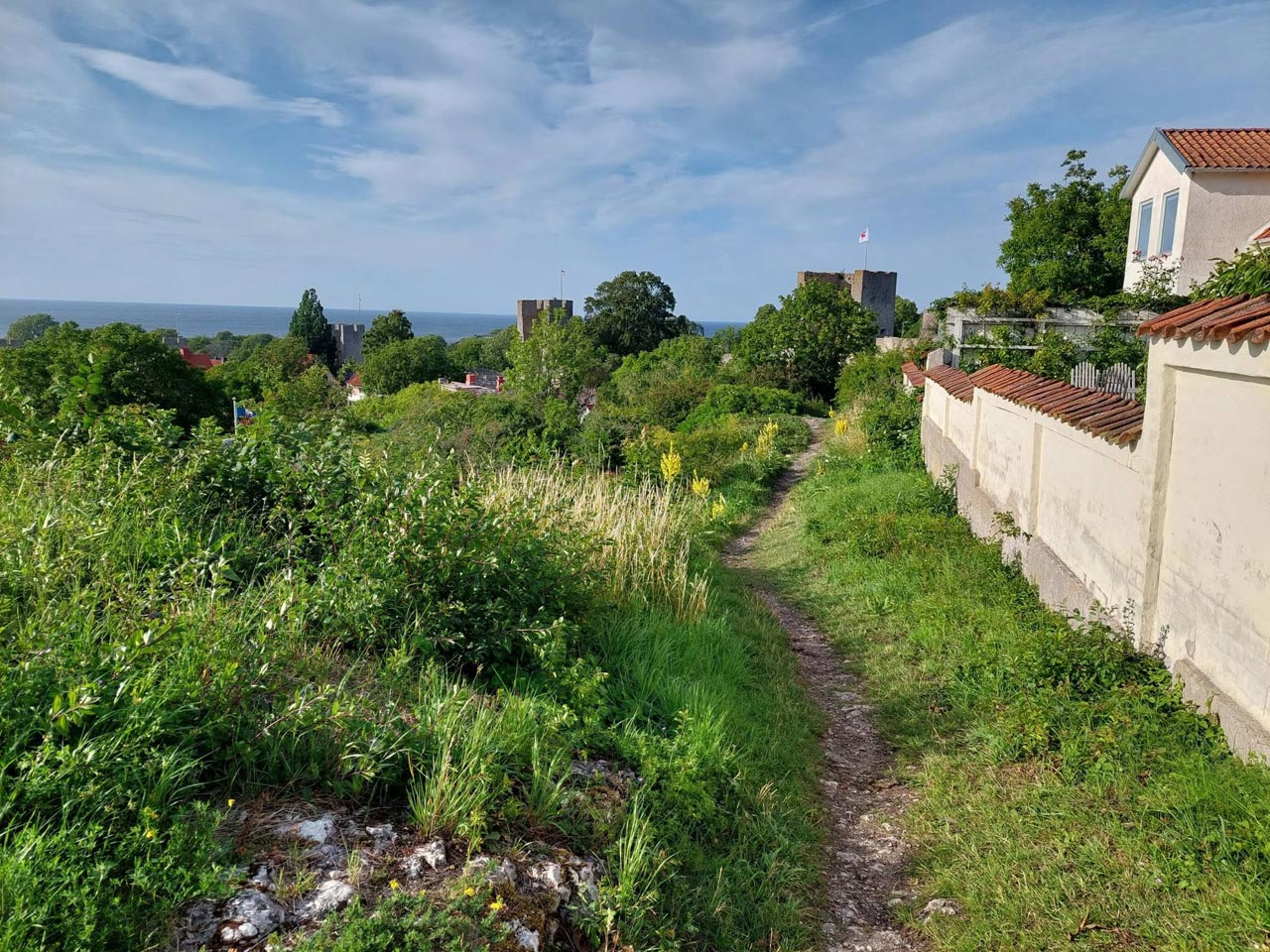
The residency stands atop a cliff formed by a rocky escarpment, somewhat away from the main entertainment hubs. Yet every evening, the wind carries music from bars and concerts taking place, who knows where, making it seem as though the town is celebrating a festival every day. Christine tells me about the upcoming Stockholm Week, when the capital’s golden youth descend on Visby to dance in beach clubs and drench one another in champagne.
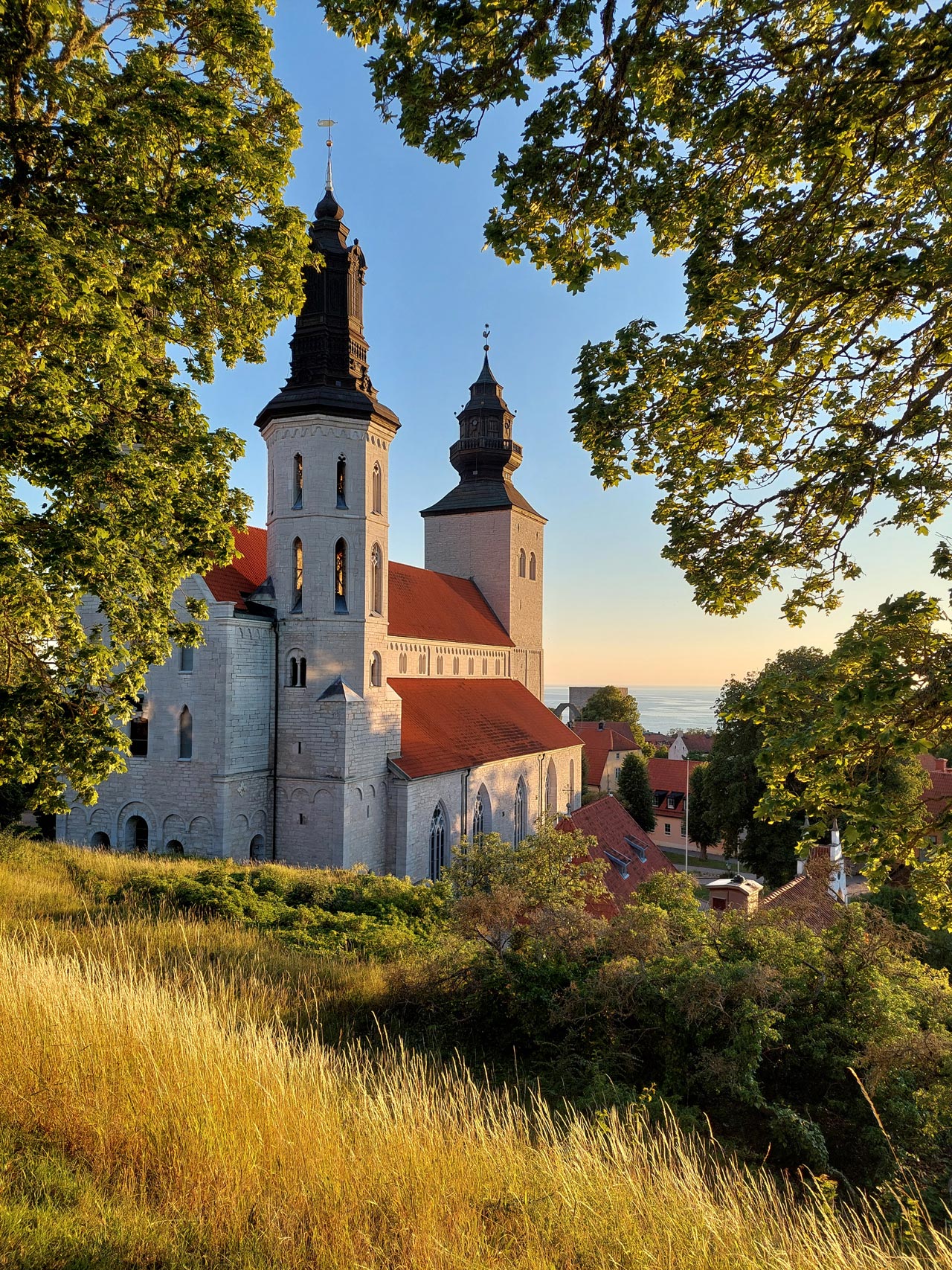
On this cliff, tour guides lead groups of visitors, showing St. Mary’s Cathedral and the panorama of the old town while recounting stories of merchants’ lives in the Middle Ages. Couples come here to watch the sunsets. Tourists wander around the residency building (it dates from 1823 and was once a free school for poor children), peering into the windows of those who write. I was lucky enough to get a room on the second floor, where it’s pretty challenging for passersby to peek through.
I step out into the courtyard, filled with blooming roses. It’s so beautiful here that it hurts. I wrote the same thing in a text from Visby in 2022. The war in Ukraine is still happening. I have just learned that Aidas Marčėnas has died. I could go on listing reasons why it seemingly shouldn’t be beautiful. How do I avoid feeling guilty? How should I begin creating and believe that what I’m doing is meaningful?
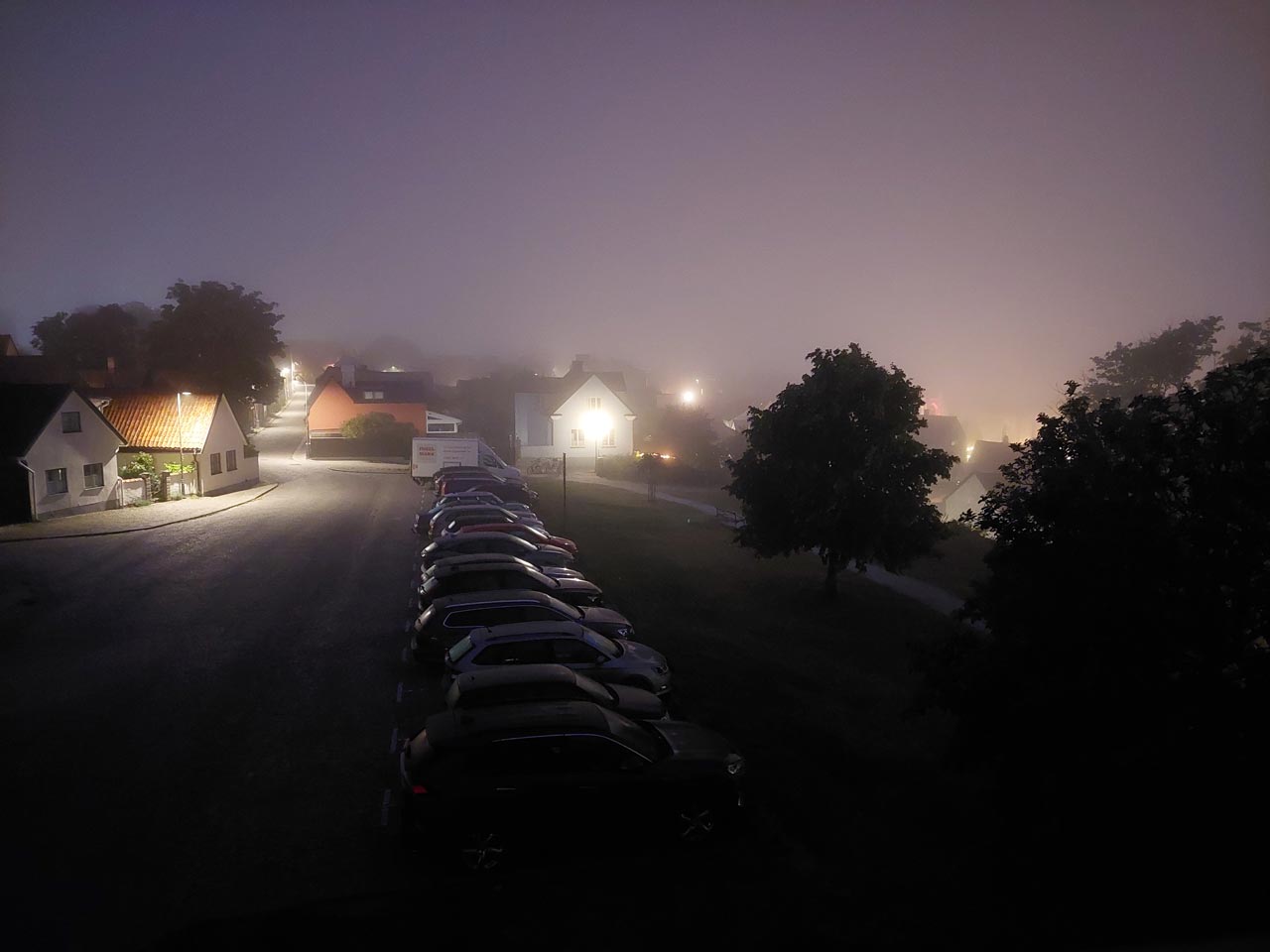
The first time I return to the sea in Visby by bicycle, the view takes my breath away. How should I describe the smell of the sea? This particular sea, in this particular place. Today, the Baltic Sea around Gotland is rough; the shoreline is strewn with seaweed, stones, and pebbles, grasses grow along the edge, and no one is swimming here. People only stroll or cycle along the paved coastal path. The smell is very strong. Stopping by a bench, you can’t help but notice it constantly; can’t stop thinking about it. It hovers somewhere between a pleasant scent that evokes the feeling of holidays and travel and a stench (of decay? Fish? Rot?). At night, this smell rises up the cliff and reaches our residency as well. How wonderful is the night. After watching football, we stepped outside. Half past midnight. There was no one around, at least not near the residency, and the island of Gotland seemed to reveal a truer face, one less shaped by the tourist season.
I exchange messages with Sabine, a poet from Germany whom I met this year at a poetry festival in Iași. I tell her I wish she were here, writing her blog every day just as she did in Romania, so that later I could read it with the help of automatic translation from German into English (it’s not that bad). The trouble with literary residencies and festivals is that they are where I meet the most interesting people. During those few days together, we grow close, as though we had known each other all our lives. But residencies end, festivals end, and we scatter. For a while, we keep in touch, sending messages, sharing photos, and occasionally calling each other. Yet gradually the connection thins and frays until those people remain only as memories, names on Facebook, somebody that I used to know.
I wonder how Slavica, the Serbian, with whom I spent time here four years ago, is doing. I should text her. There are far too few people from my past whom I contact out of the blue, just to say, “I’ve been thinking about you. How are you?” I could’ve texted or called Aidas Marčėnas in recent years; I could’ve asked how he was doing and what filled his days. But I didn’t.
“Summer, summer is wonderful. As soon as it ends, I start waiting for the next summer,” says my new friend Shota, a poet from Georgia. Shota is the only resident who smokes (normal, old-fashioned cigarettes). At lunch, he slices himself a large piece of meat. I feel less self-conscious around him, about not being quite so Western, so elegant, the sort of person who cooks proper meals and serves them to others. Shota speaks English with difficulty, but he tries very hard, and whenever he can’t find a word, he makes up for it with expressive gestures. Then again, I realize that if we spoke in his native language, I would know a different person. As it is, we are left with conversations that float along the surface.
“Are you ever afraid that your writing won’t be interesting to other people?” I ask a Norwegian screenwriter as we cycle along the coastal path.
“I think it’s important to be open and honest with yourself, not to cut corners. Then it’ll be interesting to others as well.”
This stay is different from the last one. When I was in Visby four years ago, there were fewer residents, and they mostly kept to themselves. Apart from the occasional walk I took with the Serbian translator, we rarely spent time together. This year, however, I was invited to a communal dinner almost as soon as I arrived. Every evening, in the residency library on the second floor, we watched the World Cup. When there was no football on, we watched films about Bergman or films made by Bergman himself. Together we even took the town bus to the island of Fårö twice. There, we rented bicycles and set off in search of Bergman’s house, the rauks (natural rock sculptures shaped by wind and sea), and the island’s other secrets.
Today is hot in Visby at 27 °C, while the seawater is still only 12–14 °C (on the other side of Gotland, it’s 19 °C, which is hardly fair!). So we cycled out to a limestone quarry for a swim. Nearby, a car race was taking place: lots of spectators, lots of noise, lots of dust.
“How differently people imagine leisure,” remarked Kjersti, the Norwegian writer cycling beside me.
The water in the quarry was turquoise and at the perfect temperature. On the way, we passed several trucks pumping water from the quarry. One of the drivers told us that the water would be used to fill swimming pools. Gotland has limited water resources, especially in summer, and public service campaigns urge everyone to conserve water, with slogans such as “Let your car be the dirtiest on Gotland!”
On the bus to the island of Fårö, Kjersti and I talk.
“And you?” she asks, after telling me about her son and daughter.
“No, I don’t have children. At least not yet, I hope,” I reply, repeating the answer I had already formulated for others, and change the subject because I feel a sharp pain in my chest.
“How old are you?” she asks next.
I tell her and wonder whether she thinks I am older or younger than I am, whether she is now thinking about my chances of becoming pregnant. How I wish she would answer, “Everything will be fine. You still have your whole life ahead of you.” But would that be true, or simply comforting and deceptive? All the residents here have children. They are a little older than I am, and most of their children have already finished school. The Norwegian’s daughter has just passed her driving test; the Swedish writer’s son is studying in Spain. They spend a lot of time talking to one another about their children. I stay quiet. It occurred to me that residencies like this one, which host people for three or five weeks, are probably easiest to attend when your children are already grown up. Or if you don’t have children at all.
The time I spend with the other residents, and our conversations and excursions around the island, remind me somewhat of my student days in Udine, of the time I spent with my roommates, especially because I am once again reading and selecting texts I wrote back then for a book. Of course, we were twenty at the time, whereas the residents gathered here are in their forties, fifties, and beyond. Completely different stages of life. Yet being here makes me feel much the same. As though we have been pulled out of our very different lives, jobs, and routines, separated from the people close to us, and dropped onto an island, into a residency perched on that island, where for three or five weeks we can create our own time together. I see my fears recurring. I see how difficult it is before I get to know people, how I force myself to smile and be polite, to remember the kinds of questions I should ask when meeting someone for the first time. How I still feel awkward in the shared kitchen, still slightly embarrassed that I eat things that are easy to prepare, that I don’t really know how to cook, that I keep dropping things and spilling food on my clothes. What has changed? I no longer drink (I regularly join online meetings for people with alcohol dependency). I am less categorical, less certain of my own exceptionalism. I’m painfully aware that the amount of time left to me, to all of us, has diminished. And when you stop to think about it, what truly matters?
The height of Stockholm Week. This weekend is the last chance to feel as though you are in Ibiza while in Visby. Club music pours out from Kallis, the beach club, from morning onwards. The problem is that it carries across the entire old town. Open your room window, and you practically find yourself in the club. The sea has finally warmed up (18 °C), so I invited the poet from Georgia to go for a swim with me. The poet waded in and decided it was too cold for him. I, meanwhile, went swimming. Afterward, we sat on the shore while the club music throbbed nearby. On the way home, we stopped by the botanical garden, the bass still pounding in the background. Even with the windows shut, I can hear everything! I cannot concentrate on work. Perhaps I should get on my bicycle and tour the key Stockholm Week hotspots, gathering material for future texts?
Short glittery dresses, high-heeled shoes with golden straps winding around calves. Tipsy girls sitting on the sand, stroking the dog of a man who looks like Hulk Hogan. A stage for dancing, multicolored smoke, champagne glasses, loud music, mobile phones held aloft, livestreaming the party to social media. The dress code is “golden touch.” Signs read, “VIP tables and guestlist.” Beside the club stand a limousine and two police cars. So far, there is less action than there is noise, spreading throughout Visby’s old town.
Similar music came from the yachts moored farther away. There, too, people dressed to impress were hosting private parties, with champagne bottles on every table. For a moment, I felt the urge to be on one of those yachts, dressed like them, drinking champagne, getting intoxicated alongside them. What if I bought a bottle of champagne or wine and opened it with dinner? No one here knows that I have an addiction. I shook the thought off. I returned to the residency and felt as though I had avoided danger, as if a car had passed me at high speed, missing me by a hair’s breadth.
My last day in Visby. I wake up, no longer bothered by the bells that ring every half hour. I meet up with a former classmate whom I have not seen in more than twenty years. She now lives in Sweden and works as a doctor in a small town near Örebro; she came to Gotland for a holiday. She saw my photos on Facebook and messaged me. It feels so surreal to meet after all these years in such an unexpected place. We cycle along the path by the sea, eat ice cream, and talk as if those twenty-odd years had never passed at all.
For my last dinner, I order pizzas. The pizzas, ordered through a Scandinavian app, take two hours to arrive. My Swedish-speaking colleagues offer to call the pizzeria and try to find out what happened to them. Eventually, three enormous pizzas are delivered, and we eat and laugh, recalling all the mishaps and absurd moments of the past three weeks. Tiina, an Estonian, says she has written a poem for me! We read it in three languages (with artificial intelligence providing translations into English and Lithuanian). Kjersti presents me with a handmade postcard signed by everyone, with a pressed clover leaf and a tiny daisy attached.
I know that a great deal of uncertainty awaits me when I return to Vilnius. I will have to look for a new job (on the last day of spring, the entire department was laid off, and I had worked there for nine years). I don’t know what my position will be this autumn (if I even get one), who my colleagues will be, where I will be working, or whether I will enjoy what I do. On the other hand, one ending means another beginning. If I had not been laid off, I would not have been able to come to Visby for three weeks. I would not have met Christine, Shota, the Norwegian screenwriter, Kjersti, Tiina, and all the others. It is strange how chance brings people together in life. Or perhaps a higher power, as they say in meetings for people struggling with addiction.
The original essay was published in Šiaurės Atėnai.


