
Ernestas Noreika has an alter ego in Lithuanian poetry – his rapper alias Beeta. Such an artistic identity is telling in two aspects: his texts feature an excellent sense of language, while his work gradually deals with social themes.
For quite a while, Noreika kept his poetry and his socially oriented rap separate. He never aimed to confess anything in his poems, keeping any personal experience shrouded by a thick fog of metaphors. It seems that for Noreika, a metaphor is not merely an ornament – it is a way of talking about things that cannot be said overtly. A metaphor turns pain into form, while the rhythm of language gives harmony to form. Thus, reading his melodic poetry transports the reader into a world where the beauty of image and destruction coexist.
Noreika is concerned with subconscious processes and the ruptures of inner worlds. His whole body of work puts forward the idea that people are as complex as the world that surrounds them. The poet develops this idea by creating surreal visions and utilizing a psychogeographic perspective: descriptions of the environment or of distinct phenomena symbolically reflect the subject’s inner world, memory, and trauma. Although psychogeography is traditionally associated with urban poetry (in Lithuania the foremost representative of such writing is Marius Burokas), Noreika develops it further and turns it into a way to discover the self. Therefore, it does not matter what kinds of phenomena he delves into – be it the expanses of the cosmos (Apollo) or the forces of nature (Akvanautai) – these images place the reader into subconscious loci that are not necessarily cozy places to find themselves in.
Many of Noreika’s poems speak of lost human wholeness and the factors that disrupt it. Thus, his poetry can be read as an allegory of individuality ruptured. This is also reflected by the surreal logic of his texts: they are like a collage whose details fit together like nested boxes – opening one yields another. These images, bound by association, are reminiscent of wandering, not consecutive progression. It seems that two things are happening at the same time: the subject, as if in a dream, descends into an analysis of their own inner world and at once becomes the thing affecting them. This is how Noreika develops the psychological layer of his poetry, which he uses to speak of traumatic experiences and what it means to live in our times.
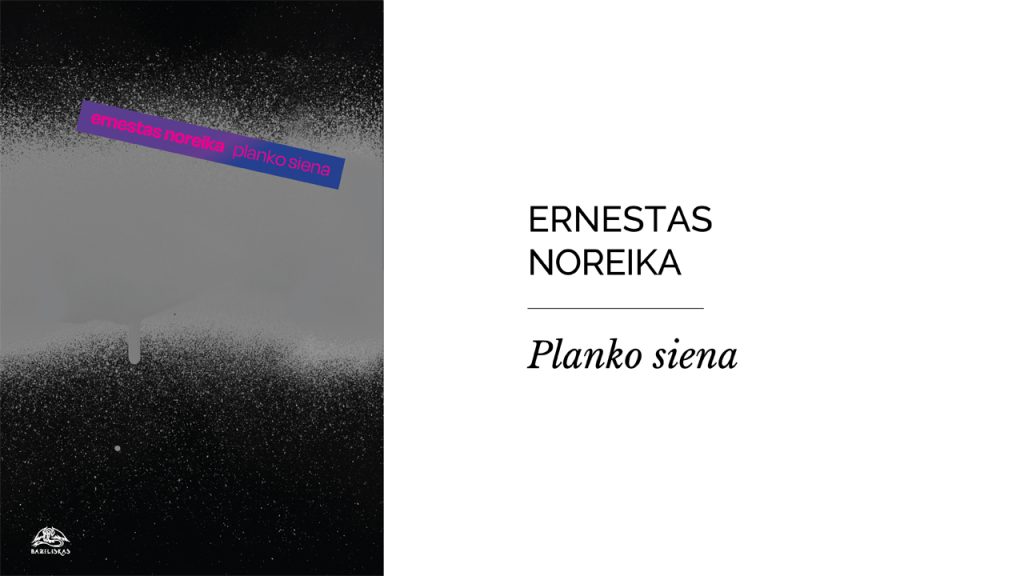
Noreika’s most recent book, Planko siena, elevates these issues to an even wider context – one of society and civilization. The book’s title, “Planck’s Wall,” describes the theoretical boundary beyond which current physics models cannot give reliable descriptions of reality. This boundary becomes both a poetic impulse and a point of reference for the book. Planko siena can be read as a dystopian commentary of reality – the book begins with a paraphrase of the Biblical line “In the beginning was the Word,” where the word is an act that begins the history of civilization, and is concluded with the poem “dante,” which paints hell as a car in need of repairs, whose roaring engine drowns out nature. Between these two points the poet establishes a woeful vision where culture, science, and religion are subverted and where humans are shaped by technology and consumerism. The interplay of darkness and light only strengthens this dystopian vision. Light, commonly associated with discovery, life, and civilizing achievements here becomes a source of instability and poetic tension; the subjects feel much safer engulfed by the primeval dusk of “ignorance.”
Even though Planko siena is based on a complex idea, reading the book is not difficult. Noreika uses well-known cultural images to reflect upon contemporary topics. In the poem “agora,” for example, a gathering place for ancient Greek philosophers is reminiscent of Facebook – a space where people “eat” each other. In “ark,” Noah’s ark, traditionally associated with humanity’s salvation, is transformed into a metaphor for putrid cattle cars that were used to deport people to Siberia. The poem also points to the darker aspects of humanity: “just come up and open them / some voice tells me / the doors have always been within you.” Such complex imagery pairs cultural processes with inner experiences and thus makes up the backbone of Noreika’s poetry: fierce language, doubt in humanist ideals, a sensation of precariousness transmitted through syncretic images, which eventually converge on the idea that evil exists in people. Noreika’s poetry diagnoses crisis and adopts its very operational logic.
The critical attitude present in Planko siena places Noreika with some other younger Lithuanian poets whose work in recent years began to express doubt in the idea of progress. Like Mantas Balakauskas, Simonas Bernotas, and Tomas Petrulis, Ernestas Noreika is inclined to emphasize alienation and how schemes and ideologies influence thinking. He criticizes consumerist society as well as the forms of authenticity and self-expression that it offers; Noreika places the subject of his poems in an artificial environment that usually has no exit, instead offering only a straight path toward the extremes. Capitalism, not unlike the mythical Saturn, has begun to devour his own children: the biological body is gradually disassembled and consumed so that the ego may acquire a new form (“agora”). Virtuality becomes the customary plane of existence, where the subject embarks on bloody missions just like in a video game, while penance is associated with domestic scenes of washing one’s dirty clothes.
Although a scathing analysis of social reality has its merits, Noreika’s mesmerizing poetic vision is the principal strength of this book. It is surprisingly performative and artistically imaginative. Noreika is a poet who is not afraid of speaking for the majority, who uses schemes and well-known tropes to create a massive, visually striking spectacle that he turns into a collective experience. This is how Planko siena acquires an aesthetic similar to blockbuster movies, which emphasize intense images, speed, and shock: “we learn to live / with emotional updates / having painted over the scars left by the asteroid / which crashed into us / millions of years ago“ (“blades”). The dystopian message generates sensations of instability and a consistent overload, reminding us that everything operates like an eternal, nightmarish engine.
However, Noreika usually comments on social phenomena using generalizing statements, without actually rethinking the fabric or the operating principles of society; we might say his poetry is, therefore, lacking in the personal and the political. In spite of this, Noreika’s poems are easily imagined on the screen or the stage – perhaps a vigorous motion picture or a performance reinforcing the impact of the text or giving form to the nightmarish atmosphere. Lastly, after reading Planko siena, we are left with an intense desire to hear the voice that spoke this vision in the first place.