
Sigitas Parulskis is one of Lithuania’s most prolific writers, having made his debut with the poetry collection Iš ilgesio visa tai (All that is due to longing, 1990). Any introduction to Parulskis must take his generation into account. A closer look at Lithuanian poetry from the past three decades reveals that the generation of poets born in the 1960s is among the most influential and widely acclaimed in contemporary Lithuanian literature. Having grown up under the Soviet regime but still relatively young when Lithuania regained its independence, this generation feels no nostalgia for the former era and bears witness to the country’s double “post-” condition: postmodernism and postcommunism, both of which shaped various aspects of life, including the arts. Therefore, it is no surprise that Parulskis’s poetry is often described as postmodern, marked by a distrust of, and a critical stance toward, human ideals and professed values. His work reinterprets religious and mythological narratives, reflects on the collapse of agrarian culture, which had served as a foundation for older generations, and explores its lingering remnants. The resulting lack of values causes the narrator pain, horror, suffering, and helplessness. The language of the poems is rough, unafraid of vulgarity or irony. At the same time, there are moments of open longing, unshielded by irony, for all that is absent and unattainable. Where does this come from? From the experience of growing up within a communist system, serving in the Soviet army, confronting the great tragedies of the twentieth century, and being unable to find answers to pressing existential questions.
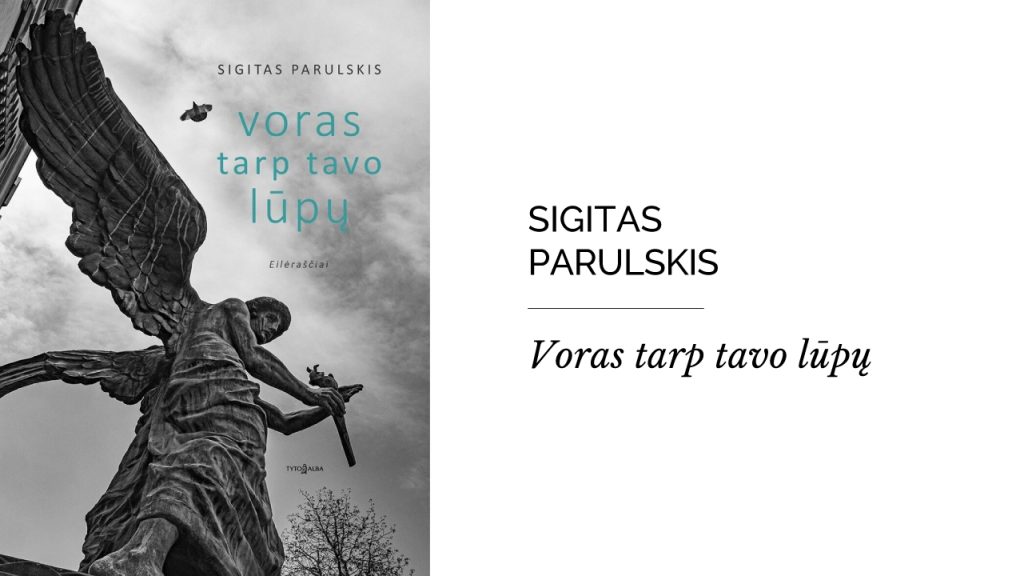
In Voras tarp tavo lūpų (A spider between your lips), Parulskis’s voice remains instantly recognizable, both in terms of content and style. Yet the changes brought about by the considerable gap between his poetry collections are equally apparent. In this book, Parulskis continues to immortalize the past in verse, to provoke through his writing about the present, and to look toward the future, which invariably ends in death. Each of these directions of the poetic gaze is painful.
Throughout the collection, doubts about humanity repeatedly surface. Although people are not inherently evil, life seems to corrupt them. In the poem “Klasiokai” (Classmates), the narrator reflects that each person is born with a blank canvas that is later stained with bodily fluids (p. 60). This idea is complemented by the recurring motif of trash. In the poem “Šiukšlės” (Trash), the narrator admits that throughout his life, he carries himself piece by piece to the dump (p. 70). The image of trash is one of the most expansive in the book, inviting deeper reflection. According to the philosopher and professor Mintautas Gutauskas, trash (which was once a useful object or part of one but has since become unnecessary) has turned into a fundamental phenomenon of human existence, capable of occupying a place within human consciousness: “… on one side, ordinary consciousness, which is limited to its field of attention and pushes trash beyond it; on the other, hyperactive ecological consciousness, which understands that trash does not disappear beyond the horizon but continues to wander uncontrollably around the planet in various forms.”1Gutauskas, M. “The phenomenology of trash in the anthropocene,” Athena, 2019, no. 14, p. 61. In other words, the narrator deliberately chooses to see within himself that which many people overlook: things that are no longer needed, discarded, corrupted, or broken. Personality traits, intellect, and erudition (p. 33), qualities ordinarily valued and celebrated, are described as inner trash. Parulskis transfers a mode of thinking enabled by the Anthropocene into poetry, transforming hyperactive ecological consciousness into a hyperactive critical consciousness and, in doing so, finds yet another way to express his distrust of what humanity chooses to exalt.
Art should stand as a counterweight to human imperfection; however, this poetry collection doubts that. In the poems “Tiesa mus išlaisvina” (The truth sets us free) and “Tuščias avilys” (Empty hive), the narrator is self-aware because he reflects on the act of writing a poem and concludes that “nothing good would come of it” (p. 13). He questions his entire bibliography (p. 66) and dismisses all words as hollow. For many years, Parulskis was a literary critic, and although he no longer writes reviews, he has consistently maintained certain convictions. The collection contains many ideas he has held for decades. Reviewing books by the canonical poets Marcelijus Martinaitis and Sigitas Geda in 1998, Parulskis characterized the predicament of his own generation: all that remained to them were the “sucked dry, hollow words”2Parulskis S. “Iš testamentų,” Šiaurės Atėnai, 1998, December 12th, p. 8. left behind by their predecessors. In a review of Dalia Bozytė’s book, published in the same year, he questioned the very notion of the professional poet, arguing that such a thing does not exist.3Parulskis S. “Literatūriškumo fenomenas,” Šiaurės Atėnai, 1998, February 14th, p. 8. The same idea reappears in the poem “Poetai profesionalai” (Professional poets): “there is no such thing; a poet is an eternal / amateur, one who enjoys, one / who savors, tastes, overeats and shits himself, / one who falls under the table and rises again” (p. 23). I have deliberately quoted more than necessary because the passage reveals an attempt to deny poets their professionalism as well as to bring them down to earth, to restore their humanity. I admit that this poem stands out somewhat awkwardly within the collection and is mildly irritating, much like “Bandymas būti šiuolaikiniu” (Trying to be contemporary). It tries a little too hard to demonstrate its own exceptionalism and disregard for contemporary fashions, yet it serves an important purpose. Strangely enough, a romanticized and spiritualized view of poetry and poets still persists in Lithuania, even among younger poets. The narrator’s message is that poetry is nothing sacred. He shifts it from the realm of the sacrum to that of the profanum through provocative, edgy, politically incorrect imagery that the editors would probably hesitate to present to an international audience. Thus, although it is difficult to take pleasure in either the poetics or the narrator’s point of view, we, as readers, have to acknowledge the poem’s message.
Humans and the art they create are this particular way because, in the collection, the world itself is shitty, full of suffering and pain. The world’s evil is generalized and abstracted. The book does not conform to the dominant tendencies of contemporary Lithuanian poetry, offering no specific references to present-day realities such as the wars in Ukraine or Palestine. A refugee from war appears only once, and even then without further elaboration. Humans are trapped in the world like dung beetles and must carry on with their shitty tasks day after day (as in the poem “darbas kaip visi” [a job like any other]). And if humanity were not inherently evil, then the world would have been doomed from the start. Existential anguish can be found in all of Parulskis’s books, yet this time his gaze seems to extend somewhat further, beyond the confines of the individual’s inner world. In this respect, A Spider Between Your Lips feels like a breath of fresh air. It does not speak of the moral degradation of our age or the decline of values (as some of Parulskis’s reviewers have argued), nor does it idealize the past. There is nothing new because things have never been better. The poem “Big Bang” should put such interpretations to rest once and for all. There, the narrator describes existence before the creation of the universe: “Only darkness and pain / pain piercing and uniform / from end to end” (p. 62). Therefore, there is no reason to proclaim an apocalypse (as right-wing political activists are often inclined to do) if this condition has persisted throughout the entire lifespan of the universe. The narrator yearns to escape it, striving toward the light, yet never succeeds. In other words, humanity longs for a light that no one has ever experienced, while things were already shitty long before the Big Bang.
Time is a crucial theme in this book. The passage of time is registered through memory and the transformations people undergo in their lives. The narrator encounters signs of time’s relentless advance: parents die, and after that, there is nothing (p. 27), children grow up, which means he himself is drawing closer to the end (pp. 44–45). The inseparability of past and present is captured in the poem “Klasiokai” (Classmates): “children’s faces frozen into the old people’s faces … young and old at the same time” (p. 60). The friends of the narrator’s youth become mirrors reflecting the continuity of time. In a few poems, the narrator shares memories of his younger years: a friend killed in the Soviet-Afghan War and the eccentric, humorously portrayed villagers of “Ežeras prisimena pavasarį” (The lake remembers spring). This poem is intertextually linked to Parulskis’s novel Kaip aš mečiau (How I quit, 2024), repeating the scene involving the fisherman Ladzis and the way human lives end and communities disappear. This shows that Parulskis’s prose and poetry are not separate domains but form a unified creative whole. The poems “Skylės pilnos kišenių” (Holes full of pockets) and “Paskutinė nuotrauka” (The last photograph) declare that everything is temporary, and there is no way to resist it. In the latter poem, we see the abundant listing of nouns, which is characteristic of Parulskis’s earlier poetry. In the poem “dantys” (teeth), the narrator acknowledges that he is weaker than death, and there are even traces of a certain reconciliation with it: “I am stockpiling reserves of dreams / for the sleep of eternity” (p. 46).
The collection also includes photographs taken by the author himself. Some resonate with the book’s recurring themes of memory and the passage of time. They show sculptures that immortalize their subjects yet have themselves been worn down by time, becoming chipped, weathered, and covered in moss. In this way, the images highlight a paradox – even objects created to preserve memories are not immune to time’s effects. Other photographs repeatedly feature wooden objects: old, worn, and no longer useful. A chair standing by a river, a damaged wooden chest, a well, which is most likely unused, a fragment of a wooden structure held together with nails, and ruins. The photographs suggest that neither stone nor wood can escape decay.
Parulskis’s latest poetry collection, A Spider Between Your Lips, is a painful book about the passage of time, the decay of all things, human imperfection, and the world’s darkness and suffering. These are conditions that people must learn to live with. Even though literature is called into question and words seem hollow, this book feels like an act of resistance, an attempt to discover something deeper and more meaningful. As the book returns to the Big Bang, it rekindles the light so desperately needed.